
Uncategorized
Christina Mills, Operations & Program Manager
 Christina is an experienced nonprofit professional and provides key project management and administrative support to the ClimateWise team. She is also experienced in communication and outreach, graphic design, and website development. Christina was previously the Project Scientist at the Institute for Energy and Environmental Research providing technical analysis to support advocacy of carbon-free and nuclear-free energy systems, in particular for Minnesota and Maryland. Publications include “Renewable Minnesota“, “Energy Efficient and Pollution-Free Space Heating and Cooling in Maryland“, and “Energy Justice in Maryland’s Residential and Renewable Energy Sectors“. She also worked as a Policy Analyst for Windustry, an organization that promotes community-based wind energy across the country.
Christina holds a J.D. from Hamline University School of Law in St. Paul, MN and a B.A. in Biology from St. Olaf College in Northfield, MN.
James Edson, GIS Specialist
 James uses custom developed Python scripts to analyze climate data for ClimateWise projects. He produces maps and data tables that show the expected changes under various emissions scenarios across the United States. He has a B.S. in Geography from the University of Oregon in Eugene, OR.
Geoff Weaver, Business & Partnerships Manager

Geoff leads business strategy and partnership activities for the Geos Institute. Geoff retired from a technology career at Intel Corp where he held various positions in marketing, strategic planning and business development. During his 18 years at Intel, he built on his prior product and strategic marketing experiences at other leading technology companies to help drive Intel’s industry initiatives and to enhance the business value of wireless and other technologies under development at Intel Labs. His focus at Geos Institute is the realization of a long held dream to transition to the non-profit world while using the business skills he developed in the technology sector.
Geoff holds a B.S. in Finance from the University of Connecticut.
ClimateWise Local Projections
Do you need help assessing future climate conditions for your community?
While climate change is a global phenomenon, the impacts are locally unique. Our team of can help you understand the likely future climate conditions specific to your community.
Geos Institute technical experts prepare local climate change projections based on the best available climate change science, presented at scales that are appropriate for local decision making. We provide maps, graphs, reports, in person presentations, and dynamic online presentations that are easy to read and understand by anyone in your community.
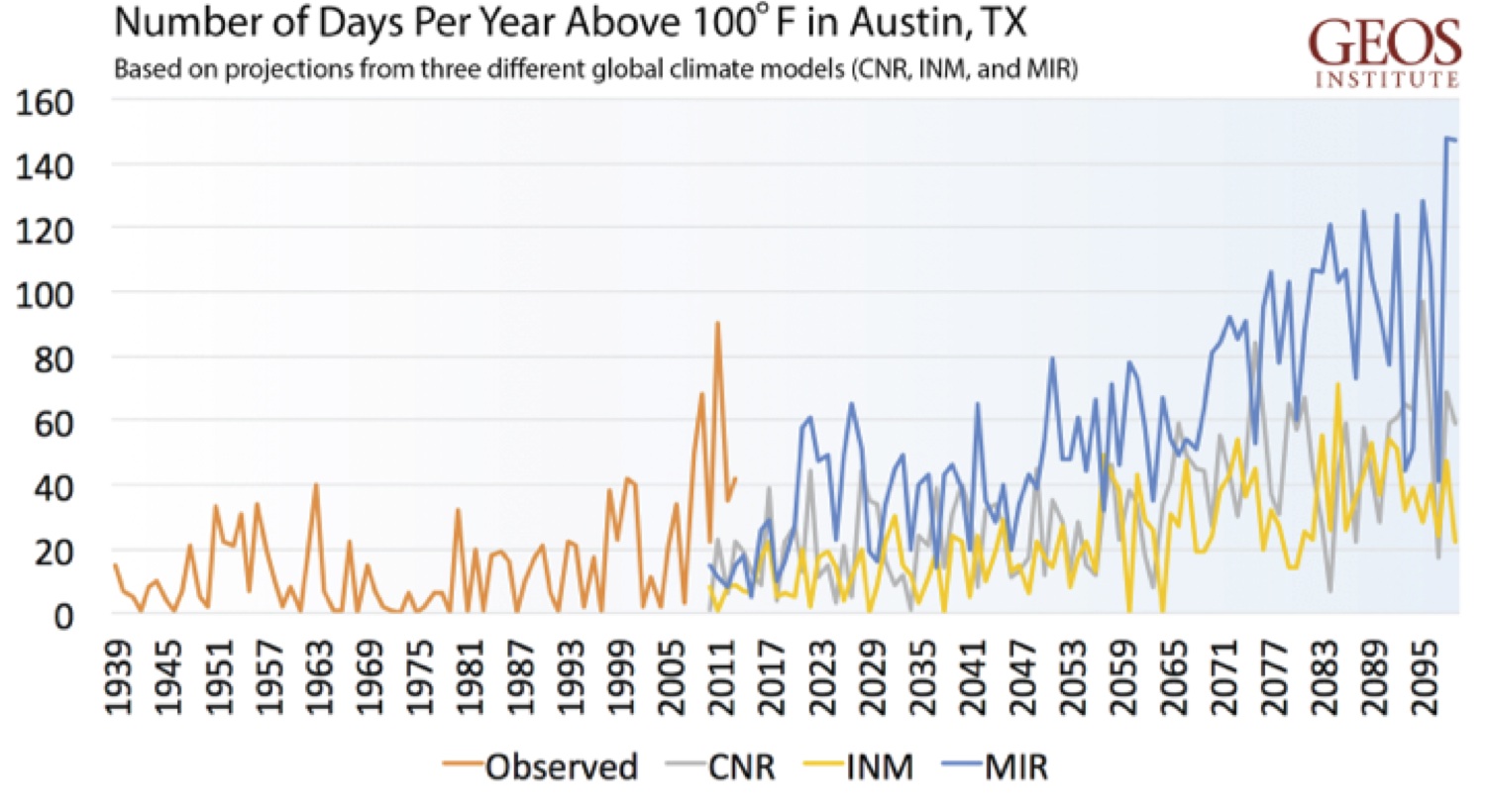
Our technical experts collaborate with the nation’s leading climate modelers to bring to you the most useful and up-to-date information for your region. We have the knowledge and relationships to navigate complex model output and data availability that is always changing. This allows you to focus on resilience strategies rather than having to learn to navigate the field of climate science.
The Geos Institute has recently updated its approach to providing local climate projections. Please visit our page on Climate Projections on the Climate Ready Communities site for more information.
ClimateWise Vulnerability Assessments
Do you need help identifying your community’s vulnerabilities to extreme and unexpected events?

Climate change is already affecting our communities through increasingly frequent and severe droughts, floods, extreme storms, sea level rise, and heat waves. And it is expected to worsen over the next few decades, even if we drastically reduce emissions today. While climate change is a global phenomenon, the impacts are local.
In addition to reducing emissions to prevent catastrophic impacts to future generations, we need to prepare communities for severe impacts by building resiliency at the local level.
One of the first steps in creating a resilient community is identifying what resources and populations are most vulnerable to climate change. Water supply, for instance, is often highly vulnerable to climate change in areas that rely on snowpack for water storage, and in areas where precipitation is expected to become less predictable over time. Most communities have existing stressors, such as poverty, unemployment, or pollution that can increase the vulnerability of certain populations and resources. These stressors also need to be considered.
Getting Started
Taking the first steps in your community
 Climate change can be overwhelming and scary. And almost everyone at some point feels like shutting down and pretending it is not really happening. But it is happening. And we can do better than shutting down.
The important thing is to GET STARTED. Your community can be made more resilient with a wide variety of actions – but continuing to do things the way you have always done them is not a viable option.
We suggest you do three things:
- Get involved in community efforts to address climate change if they already exist or start them if they do not. Getting your community to conduct a vulnerability assessment is a great way to get started at the community scale.
- Do what you can, in your own life, to reduce your carbon footprint. It will not only have an impact on the larger problem, it will also make you feel more energized for doing the work that needs to be done in your community.
- Remember that you are not alone. You might not know exactly who they are, but in every community the polls tell us that MOST people are becoming increasingly concerned about climate change.
It is important to remember that climate change adaptation is work that will never be finished in our lifetime. Whatever your role in local government, industry, or your community, you will never clear your desk on this issue.
And, it might be the most important work you ever do. Preparing for climate change impacts and reducing community vulnerabilities WILL SAVE LIVES AND MONEY.
Addressing the impacts of climate change and building local resiliency is an ongoing process that must become a primary consideration for all parts of your community if you are to be successful in strengthening and maintaining the quality of life for your citizens.
Whether you choose to work with us or another service provider, please keep in mind that the more you integrate across your community and develop whole community solutions, the stronger and more resilient your community will be.
Here are some additional resources to help you in your efforts:
- Climate Adaptation Knowledge Exchange – adaptation case studies, tools, networking
- Georgetown Climate Center – adaptation resources, toolkits for coastal communities and heat island effects, including funding.
- ClimateAccess – resources for communicating about climate change
- Institute for Sustainable Communities – Sustainable Communities Leadership Academy
We hope this information has been helpful for you as you consider how best to serve your community during this time of change.
Climate Resilience Planning
Are you looking for a collaborative approach to building community resilience?
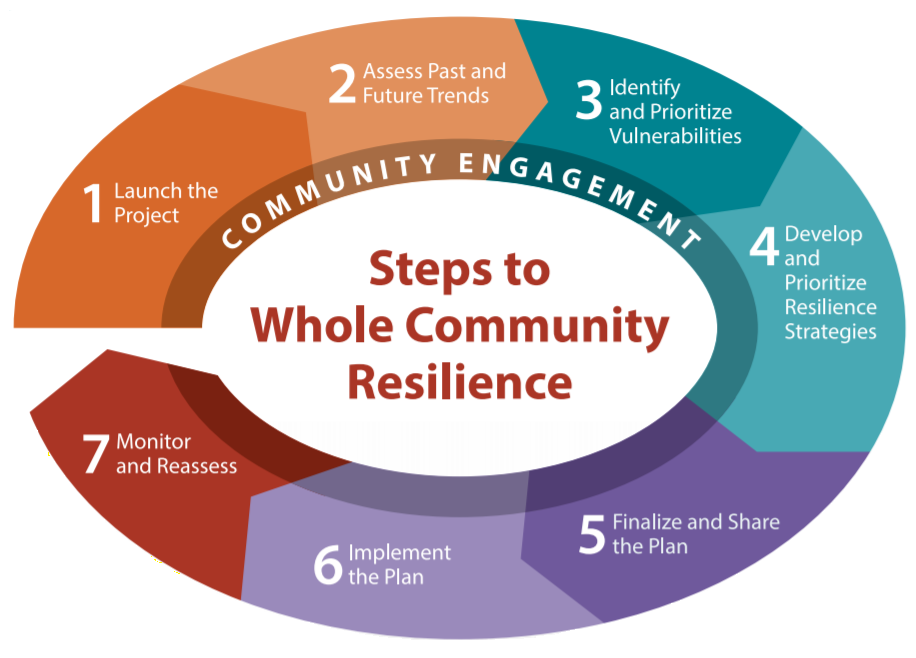
Building on experience gained by working with communities over the past 10 years, our team has developed the Whole Community Framework to help communities build resilience in the face of changing climate conditions.
The Whole Community framework starts with understanding the community’s most valued resources, then develops local climate change projections and a cross-sector vulnerability assessment. Once vulnerabilities are assessed and impacts prioritized, strategies are developed to address the priority vulnerabilities and increase their community’s resilience across all sectors and populations.
A systems view is key to developing these strategies. Thoughtful development of collaborative, and cross-sector strategies can lead to a whole suite of synergies – cost savings, new partnerships, complementary efforts, and less community conflict.
A community may utilize the Whole Community framework in one of two ways: a) through a professional services consulting engagement with the ClimateWise team at Geos Institute, or b) by utilizing the Climate Ready Communities assisted do-it-yourself program.
If your community prefers a consulting engagement, the typical path is an RFP for climate resilience planning as a whole or just for key components of the process, such as to develop a vulnerability assessment. See our suggestions for developing your RFP here.
We also welcome questions if you are just getting started with developing your RFP. Email Geoff Weaver at geoff@geosinstitute.org
If your community’s resources for climate resilience planning are limited and/or you prefer to build capacity in this area rather than utilizing a consultant to guide the process, we suggest you consider our Climate Ready Communities program. Here is an overview of the program, and most communities with an interest in this approach begin by downloading the comprehensive Practical Guide to Developing Climate Resilience.
Whole Community Adaptation
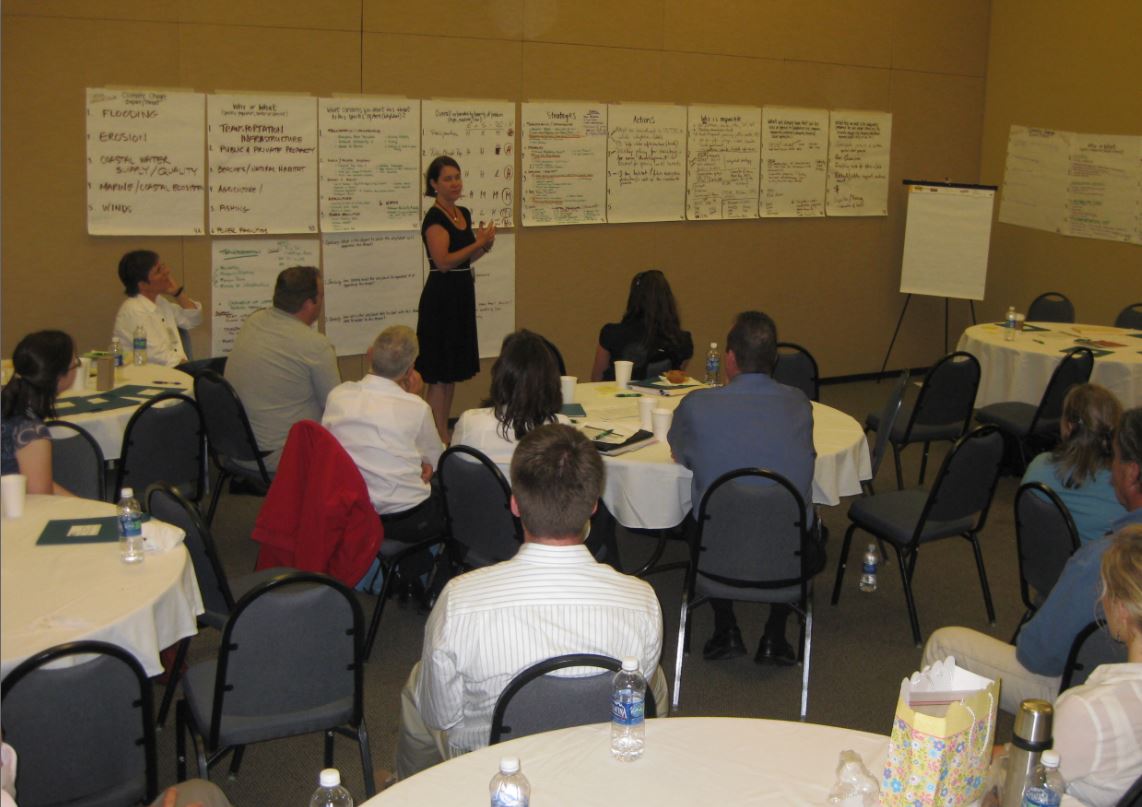 Understanding the challenge and opportunity of climate change from a Whole Community perspective
Climate change presents major challenges to all parts of our communities, including water resources, human health, the economy, emergency preparedness, natural systems, and many others. If each city department or community sector responds to the changes without consulting with one another, there will be conflict, redundancy, and wasted resources now and in the future. The complexity and all-encompassing nature of climate change mean that we need a new approach to developing long lasting and collaborative solutions.
Since 2008, our ClimateWise team has been working with communities and colleague organizations in various states to determine the best approach for local leaders to use when addressing the complex and inter-related impacts of a changing climate.
Our experiences with these communities has led us to develop a framework we call Whole Community Adaptation. Whole Community Adaptation integrates solutions:
- among diverse sectors within a community, including vulnerable populations
- among neighboring communities
- between adaptation and efforts to reduce greenhouse gas pollution; and
- among different levels of government (local, state, federal)
Whole Community Adaptation is a holistic approach to climate change preparedness that addresses impacts across a community in ways that are cost effective and create multiple community benefits. Whole Community Adaptation can be achieved using a variety of methods as long as the following three primary components are included:
Multi-stakeholder Engagement
Get people involved. Each community has different groups of people who will be impacted in different ways by changing conditions. Each group, including many non-traditional partners, needs to be engaged in order to explore and address their specific vulnerabilities to climate change and other stressors.
Cross-sector Strategy Development
Bring diverse community sectors together to assess vulnerabilities and develop strategies. By developing strategies that work across different sectors, you will create co-benefits, save resources, and create overall community resilience.
Learning and Improvement over Time
Monitor, reassess, and be ready to change course, as needed. Across the country, community leaders are grappling with new challenges. Their innovations play a critically important role in our collective ability to build resilience. Some of those innovations will work and some will not. What is important is that local leaders make smart and transparent decisions, learn from new information, and remain flexible.
Whole Community Adaptation is an eminently fair framework that solves problems rather than shifting the risk to other sectors or future generations. At the same time, communities that use this framework support their most vulnerable people and resources, rather than having them bear the brunt of climate change and other stressors.
By taking a Whole Community approach, communities can develop strategies that reflect local values and address changing conditions while:
- addressing existing community stressors
- restoring and maintaining ecosystem function
- creating benefits across multiple sectors
- spurring community support for emissions reductions
- preventing future resource conflicts
- saving money over time
To learn more about the tenets of Whole Community Adaptation, read our recently published paper Whole Community Adaptation to Climate Change. Feel free to contact us for a reprint if you would like the full article.
Our ClimateWise Program is one example of a Whole Community Adaptation framework.
ClimateWise® Request For Partnership Information
 The Geos Institute’s ClimateWise® Program offers a science-based process that emphasizes the local community’s unique situation and needs, and integrates social, economic, and environmental issues in developing local solutions to the threat of climate change. Our process takes a non-‐political, risk assessment approach to planning for future conditions.
Our services are currently available to communities that may not otherwise have the resources to take a proactive approach to climate change planning. Our grant funding allows us to provide scientific and facilitation services to the communities chosen.
Each new ClimateWise® location requires the commitment of a locally-respected organization (convening partner) that drives the process and serves as the local face for ClimateWise®. Examples of convening partners include city, county, or tribal government, regional planning organizations, watershed councils, chambers of commerce, and non-governmental civic organizations. We invite potential convening partners to submit a request for us to undertake a ClimateWise project in their region.
For more information contact: Marni Koopman, Climate Change Scientist, via email: marni (at) geosinstitute.org, or call 541.482.4459 x 303.
Learn more about the ClimateWise® program by clicking the links below:
- ClimateWise® Services
- ClimateWise® Completed projects
- ClimateWise: Helping communities prepare for a changing climate
Click here to download a description of the ClimateWise procedure and summaries of some outcomes.
 dummymodelreport.pdf