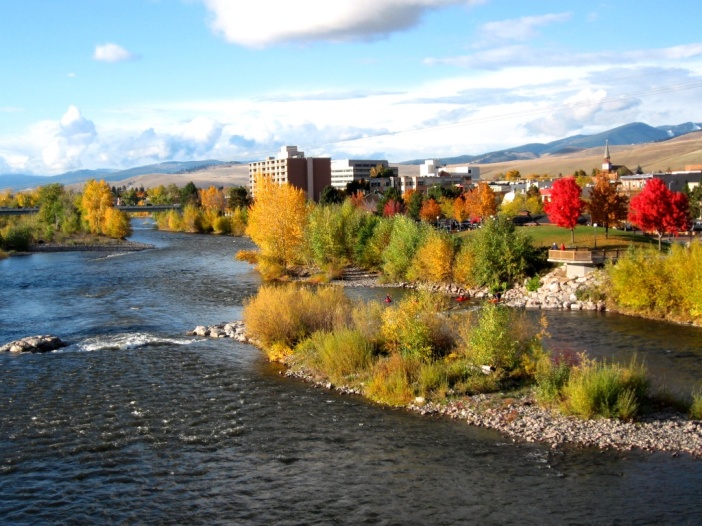
Missoula County is host to a diversity of people, local industries, intact ecosystems, and dramatic scenery. Its rivers and forests provide abundant opportunity for outdoor activities, while the university and downtown Missoula provide culture and entertainment. When people are asked why they live in Missoula County, they often refer to the high quality of life.
The Geos Institute, based in Ashland, Oregon, has developed tools and methodology to help communities respond and adapt to the pressures of climate change. Yesterday, I attended a presentation at the GIS in the Rockies by Jessica Leonard, geospatial analyst at the institute, and learned more about their approach and their projects. Leonard stated at the start of her talk that, “GIS helps us become visionary rather than reactionary.”
Conservation groups, logging industry critical of draft as Friday deadline nears
The Bulletin By Jeff Barnard / The Associated Press
GRANTS PASS — After months of tinkering, the Obama administration is due out this week with its last-ditch plan for saving the northern spotted owl from extinction. Read more…
Fresno County’s vibrant agricultural economy, scenic slopes of the southern Sierra Nevada range, and dramatic rivers beginning at the highest elevations and extending across the valley floor make the Fresno region a special place. Many future changes are expected, however, and many challenges already affect the quality of life in Fresno County and the surrounding region.
The Geos Institute’s ClimateWise® Program offers a science-based process that emphasizes the local community’s unique situation and needs, and integrates social, economic, and environmental issues in developing local solutions to the threat of climate change. Our process takes a non-‐political, risk assessment approach to planning for future conditions.
Our services are currently available to communities that may not otherwise have the resources to take a proactive approach to climate change planning. Our grant funding allows us to provide scientific and facilitation services to the communities chosen.
Each new ClimateWise® location requires the commitment of a locally-respected organization (convening partner) that drives the process and serves as the local face for ClimateWise®. Examples of convening partners include city, county, or tribal government, regional planning organizations, watershed councils, chambers of commerce, and non-governmental civic organizations. We invite potential convening partners to submit a request for us to undertake a ClimateWise project in their region.
For more information contact: Marni Koopman, Climate Change Scientist, via email: marni (at) geosinstitute.org, or call 541.482.4459 x 303.
Learn more about the ClimateWise® program by clicking the links below:
Climate change is a global phenomenon that has the potential for severe local impacts to agriculture, human health, natural resources, infrastructure, emergency response needs, tourism, and many other facets of society. Climate change impacts are expected to exacerbate the vulnerability of certain populations and sectors of society. By identifying and addressing underlying vulnerabilities early, decision makers in San Luis Obispo can increase the resilience of both the community and the resources it depends on to climate change.
There are now a wide range of more fuel-efficient vehicles that produce less greenhouse gas pollution. Before buying or renting a vehicle, check out EPA’S Green Vehicle Guide and the EPA/DOE Fuel Economy Guide Website. The Green Vehicle Guide describes emissions of air pollution and greenhouse gases for each model, and the Fuel Economy Guide focuses on fuel efficiency, including side-by-side fuel economy comparisons.
Office equipment and electronics use energy even when idle or on stand-by. To save energy and reduce greenhouse gas pollution, activate the power management features on your computer and monitor, unplug laptop power cords when not in use, and turn off equipment and lights at the end of the day. Consider using a power strip that can be turned off when you’re finished using computers, printers, wireless routers, etc.

 Reports and Handouts:
 Reports:
 The Geos Institute’s ClimateWise® Program offers a science-based process that emphasizes the local community’s unique situation and needs, and integrates social, economic, and environmental issues in developing local solutions to the threat of climate change. Our process takes a non-‐political, risk assessment approach to planning for future conditions.


 dummymodelreport.pdf