
Whole Community Adaptation
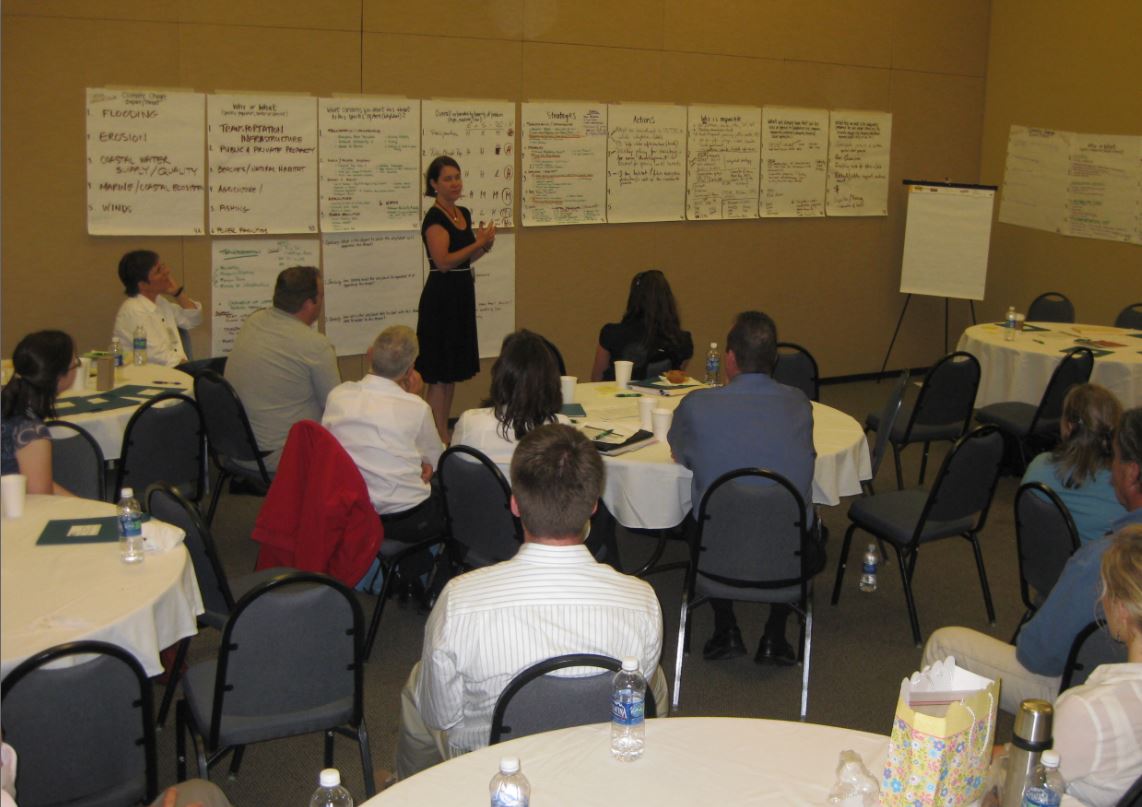 Understanding the challenge and opportunity of climate change from a Whole Community perspective
Climate change presents major challenges to all parts of our communities, including water resources, human health, the economy, emergency preparedness, natural systems, and many others. If each city department or community sector responds to the changes without consulting with one another, there will be conflict, redundancy, and wasted resources now and in the future. The complexity and all-encompassing nature of climate change mean that we need a new approach to developing long lasting and collaborative solutions.
Since 2008, our ClimateWise team has been working with communities and colleague organizations in various states to determine the best approach for local leaders to use when addressing the complex and inter-related impacts of a changing climate.
Our experiences with these communities has led us to develop a framework we call Whole Community Adaptation. Whole Community Adaptation integrates solutions:
- among diverse sectors within a community, including vulnerable populations
- among neighboring communities
- between adaptation and efforts to reduce greenhouse gas pollution; and
- among different levels of government (local, state, federal)
Whole Community Adaptation is a holistic approach to climate change preparedness that addresses impacts across a community in ways that are cost effective and create multiple community benefits. Whole Community Adaptation can be achieved using a variety of methods as long as the following three primary components are included:
Multi-stakeholder Engagement
Get people involved. Each community has different groups of people who will be impacted in different ways by changing conditions. Each group, including many non-traditional partners, needs to be engaged in order to explore and address their specific vulnerabilities to climate change and other stressors.
Cross-sector Strategy Development
Bring diverse community sectors together to assess vulnerabilities and develop strategies. By developing strategies that work across different sectors, you will create co-benefits, save resources, and create overall community resilience.
Learning and Improvement over Time
Monitor, reassess, and be ready to change course, as needed. Across the country, community leaders are grappling with new challenges. Their innovations play a critically important role in our collective ability to build resilience. Some of those innovations will work and some will not. What is important is that local leaders make smart and transparent decisions, learn from new information, and remain flexible.
Whole Community Adaptation is an eminently fair framework that solves problems rather than shifting the risk to other sectors or future generations. At the same time, communities that use this framework support their most vulnerable people and resources, rather than having them bear the brunt of climate change and other stressors.
By taking a Whole Community approach, communities can develop strategies that reflect local values and address changing conditions while:
- addressing existing community stressors
- restoring and maintaining ecosystem function
- creating benefits across multiple sectors
- spurring community support for emissions reductions
- preventing future resource conflicts
- saving money over time
To learn more about the tenets of Whole Community Adaptation, read our recently published paper Whole Community Adaptation to Climate Change. Feel free to contact us for a reprint if you would like the full article.


 Solar panels are cheaper than they have ever been, and many state and local rebates are in place to make them even cheaper. Electric cars are now affordable and there are many models to choose from. Public transportation is becoming more widely available. Telecommuting and teleconferencing technology have revolutionized remote communications. It is easier than ever make positive choices that support the local economy, save money and time, and take fossil fuels out of our daily lives.

 The
The  The
The  The amount of carbon dioxide (CO2) in our atmosphere, measured in parts per million or “ppm”, provides us with a tangible way to measure global warming trends. Atmospheric carbon dioxide measurements have been collected directly at Mauna Loa Observatory on the island of Hawai’i for 50 years.